Health Guide · A planner you can print
Your 2027 Fat-Loss Plan Starts Before January
Updated . Added a tracker-only print option and wrapping fields for your two habits.
Every January, the plan gets big. Then real life shows up. So first of all, make a plan for real life. Use November to test it, December to make it easier, and January to see what is actually working. There is no prize for making it harder.
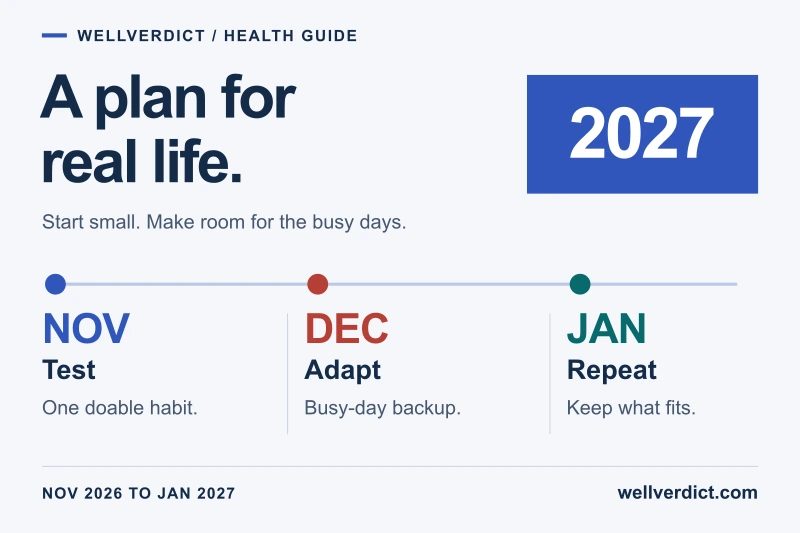
A plan for real life
Nov: testChoose habits you can keep.
Dec: adaptKeep a backup for busy days.
Jan: repeatReview what fits your real week.
First, understand your starting point.
The plan can change with your life.
After 40, look beyond willpower.
Your needs can change.
Muscle tends to decline with age. That can reduce the energy your body uses at rest.
Fat location can shift.
Menopause can favor fat storage around the middle. It is not the only reason weight changes.
Recovery matters too.
Sleep disruption, stress and less activity can make a routine harder to keep.
Not every woman over 40 is menopausal. Choose goals with your health and circumstances in mind.
Give each month one job.
Test it.
Choose two small habits. Find the awkward days before they find you.
Keep it doable.
Plan around gatherings, travel and late nights. A smaller routine still counts.
Review it.
Keep what fits. Change one obstacle, not your entire life.
Ten minutes with your real calendar.
Start here before you choose a habit. A crowded week needs a different plan from a quiet one.
| Look ahead | Make one decision |
|---|---|
| Busiest evenings | Tuesday pickup runs late; Thursday is a family appointment. Put a backup meal on those days. |
| A realistic time | After lunch on Monday, Wednesday and Friday: a suitable 10-minute walk. The time is an example, not a prescription. |
| Bad weather | Choose an indoor option you can do safely. Do not turn an icy sidewalk into a commitment test. |
| Someone who can help | Ask a friend to join one walk, or share a dinner task with someone at home. |
My difficult day and backup
When and where I will begin
Build the week, not a perfect day.
Movement, meals and a smaller backup.
Walking helps. Strength belongs here too.
- Monday30-minute walk
- Tuesday30-minute walkStrength day
- Wednesday30-minute walk
- Thursday30-minute walk
- Friday30-minute walkStrength day
Check the pace: at moderate intensity, you can talk but not sing. A pool session or suitable cycling can replace a walk.
Check the strength work: use suitable bands, weights or body-weight exercises across the major muscle groups.
This is an example health baseline, not a guaranteed fat-loss dose or a beginner's starting target. Start smaller if needed; short activity blocks count. Adults 65+ also need balance activities.
For a medical condition or exercise limitation, ask what is appropriate for you before increasing activity.
Pick two habits. Give them a backup.
| Habit | Ordinary day | Busy day |
|---|---|---|
| Food | Include a protein food and vegetables at dinner. | Try ready-to-eat beans with a grain and vegetables cooked according to their package. |
| Movement | Use the walk or strength session you planned. | Do a shorter suitable session. Reschedule the rest. |
| Sleep | Keep a regular bedtime. | Protect a wind-down window. |
My first habit
My backup
An event day is still a day.
- BeforeDecide which part of your normal routine can stay.
- DuringEnjoy the gathering. Skip the “I have ruined everything” story.
- AfterReturn to your next ordinary meal and activity. No punishment workout.
A missed habit can show where the plan needs more flexibility. Illness, caregiving, money and energy matter too.
Try it. Notice it. Adjust it.
One manageable week at a time.
January 2027, one week at a time.
January 1–3: choose your habits and check your calendar.
Write down the actual obstacle.
Make the hardest habit easier.
Keep the useful backup.
Choose what carries into February.
Your week. Not somebody else's.
| Day | Habit A | Habit B |
|---|---|---|
| Mon | ||
| Tue | ||
| Wed | ||
| Thu | ||
| Fri | ||
| Sat | ||
| Sun |
Type your two habits and tick here, or print and write on it. Entries are not sent to us and are not saved by the site; a refresh may clear them. Print before leaving if you want to keep your week.
A useful win: preparing dinner more often or finding movement you can repeat counts as progress, even when the scale gives you little information.
Review the plan, not your willpower.
- The same obstacle keeps coming up?
- Change the time, place or preparation.
- The plan is too much?
- Use the smaller version.
- It fits your week?
- Keep it before adding more.
What worked this week?
What got in the way?
My one change next week
Next review date
What this planner cannot promise.
No fixed pounds.
Your rate of change is individual.
No chosen fat spot.
Habits do not choose where fat comes off.
Maintenance can matter.
Preventing further gain may be the right goal for some adults.
Planning supports consistency. Fat loss generally requires an energy deficit over time; this tracker does not measure that.
Evidence and useful reading
- NIDDK: making a plan, handling setbacks and finding support
- CDC: setting realistic habits and reviewing progress
- NIDDK: weight loss is not the right goal for every person
- CDC: activity, energy balance and weight
- Human Movement, 2022: review of localized exercise and fat loss
- The Menopause Society: aging, menopause and weight changes
- CDC: weekly activity and strength guidelines
- CDC: moderate intensity, strength and balance
- NIA: variety and protein foods
Use these templates to plan and review your habits. Sources checked October 3, 2026.